


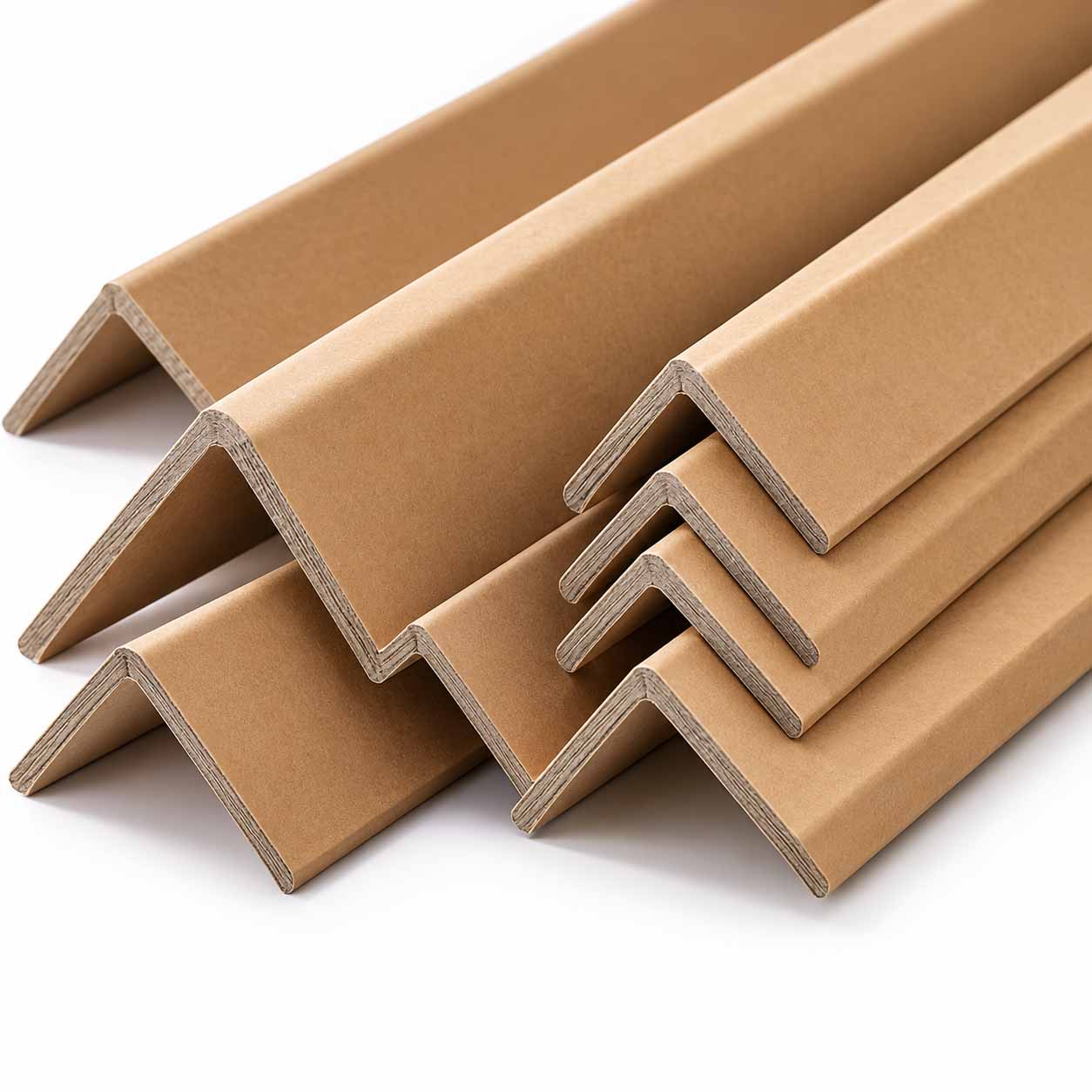
Cardboard edge protectors are essential industrial packaging materials used to protect the corners and edges of products during storage, palletizing, handling, and transportation. They help improve load stability, distribute strapping pressure, and reduce the risk of damage throughout the supply chain. For manufacturing facilities, logistics companies, exporters, and businesses handling large shipment volumes, cardboard edge protectors provide a practical and cost-effective packaging solution.
So, what are cardboard edge protectors used for, which industries use them, and how do you choose the right cardboard edge protector? In this comprehensive guide, we explore their functions, applications, benefits, available types, and important considerations when purchasing cardboard edge protectors in bulk.
What Is a Cardboard Edge Protector?
A cardboard edge protector is a protective packaging component manufactured by bonding and compressing multiple layers of paperboard using specialized adhesives. It typically features an L-shaped profile designed to reinforce the corners and edges of products, improve pallet load stability, and reduce damage during handling and transportation.
Cardboard edge protectors are available in different lengths, wing widths, and thicknesses. These specifications are selected according to product weight, pallet configuration, storage conditions, and transportation requirements.
Industrial cardboard edge protectors are widely used by manufacturers and distributors that regularly handle palletized goods and require consistent packaging performance.
What Are Cardboard Edge Protectors Used For?
The primary purpose of cardboard edge protectors is to protect product edges and corners while supporting the structural integrity of packaged loads. However, their applications extend beyond basic corner protection.
1. Protecting Product Corners and Edges
Product corners and edges are particularly vulnerable to impacts, compression, and friction during transportation.
Cardboard edge protectors create an additional protective layer that helps reduce the risk of crushing, scratches, and deformation.
This protection is especially valuable when transporting furniture, household appliances, corrugated boxes, panels, and other products with exposed or sensitive edges.
2. Improving Pallet Load Stability
Products stacked on pallets may shift or become unstable during handling and transportation.
When used together with stretch film and strapping systems, cardboard edge protectors help maintain proper alignment and support load stability.
For this reason, pallet edge protectors are commonly used in warehousing, distribution, and industrial shipping operations.
3. Distributing Strapping Pressure
Plastic and polyester straps are frequently used to secure palletized loads. However, excessive strapping tension can create concentrated pressure on product edges.
Cardboard edge protectors form a protective barrier between the straps and the packaged products, helping distribute pressure across a larger surface area.
This can reduce the risk of crushed cartons, damaged packaging, and product deformation.
4. Supporting Proper Stacking
Cardboard edge protectors can help maintain the alignment of stacked products when incorporated into a properly designed packaging system.
However, they should not be considered a standalone solution for increasing pallet load-bearing capacity. Their performance depends on the protector’s specifications, the characteristics of the load, and the overall packaging configuration.
5. Reducing Transportation Damage
Products may undergo several handling stages before reaching their destination, including loading, unloading, warehousing, and transportation.
Properly selected cardboard edge protectors help reduce damage to vulnerable corners and edges throughout these processes.
Which Industries Use Cardboard Edge Protectors?
Cardboard edge protectors are widely used across industries that transport palletized goods or require additional protection for product corners and edges.
Major industries include:
- Food and beverage manufacturing
- Furniture and wood products
- Home appliances and electronics
- Glass and ceramics
- Metal and steel manufacturing
- Automotive and automotive components
- Paper and packaging
- Textile manufacturing
- Construction and building materials
- Logistics and warehousing
- Export-oriented manufacturing
Cardboard Edge Protectors in the Food and Beverage Industry
Food manufacturers frequently ship products in corrugated cartons stacked on pallets.
For packaged foods, beverages, canned goods, flour products, pulses, and similar products, maintaining pallet stability is important for safe transportation.
Cardboard edge protectors for food packaging help support carton edges and improve load stability when used with suitable stretch wrapping and strapping systems.
They are particularly useful for manufacturers shipping large quantities of packaged products to wholesalers, retailers, and distribution centers.
Cardboard Edge Protectors in the Furniture and Wood Industry
Furniture and wood-based products are often vulnerable to damage along their corners and edges.
Products such as tables, cabinets, shelves, doors, MDF panels, and laminated boards may require additional protection during packaging and transportation.
Using cardboard edge protectors in furniture packaging can help:
- Protect panel edges from impacts
- Reduce corner crushing and deformation
- Improve packaging consistency
- Distribute strapping pressure
- Minimize damage caused by contact between products
When selecting cardboard edge protectors for furniture packaging, manufacturers should consider product weight, surface sensitivity, dimensions, and shipping conditions.
Cardboard Edge Protectors in the Home Appliance and Electronics Industry
Household appliances and electronic products require protection against physical impacts and packaging deformation during transportation.
Cardboard edge protectors may be used alongside other protective packaging materials for refrigerators, washing machines, dishwashers, televisions, and similar products.
Reinforcing the corners of large packaged products can help improve protection during storage and distribution.
For electronic products, it is important to distinguish physical protection from electrostatic discharge protection. Standard cardboard edge protectors do not replace specialized ESD packaging where electrostatic protection is required.
Cardboard Edge Protectors in the Glass and Ceramics Industry
Glass and ceramic products are particularly vulnerable to breakage, cracking, and edge damage.
Cardboard edge protectors may be used when packaging glass panels, ceramic tiles, porcelain products, and other fragile materials.
Their main functions include:
- Protecting vulnerable edges
- Distributing strapping pressure
- Supporting pallet load stability
- Complementing other protective packaging materials
For heavy or fragile products, protector thickness, compression resistance, and overall packaging design should be carefully evaluated.
Cardboard Edge Protectors in the Metal and Steel Industry
Metal sheets, profiles, pipes, and industrial components may require specialized packaging due to their weight and geometry.
Strapping systems used to secure these products can generate considerable pressure along exposed edges.
Heavy-duty cardboard edge protectors, when manufactured with suitable strength characteristics, can help distribute strapping pressure and protect product surfaces.
However, standard cardboard protectors may not be sufficient for extremely heavy products or sharp metal edges. Additional protective materials may be necessary depending on the application.
Cardboard Edge Protectors in the Automotive Industry
Automotive manufacturers and suppliers regularly transport metal, plastic, and electronic components between production facilities, warehouses, and assembly plants.
Cardboard edge protectors can be used to reinforce palletized cartons containing automotive components.
For automotive suppliers, standardized packaging solutions help improve handling consistency and support efficient logistics operations.
Cardboard Edge Protectors in the Paper and Packaging Industry
Paper rolls, cardboard sheets, corrugated board, and other packaging materials require careful handling during transportation.
When these products are stacked or secured with straps, concentrated pressure may damage their edges.
Cardboard edge protectors help distribute this pressure and support the safe transportation of paper-based products.
Cardboard Edge Protectors in the Textile Industry
Textile manufacturers regularly ship fabric rolls, yarn cartons, garments, and other products in large quantities.
Cardboard edge protectors can be used to reinforce palletized textile cartons and help maintain load integrity during storage and transportation.
Cardboard Edge Protectors in the Construction and Building Materials Industry
Construction products such as ceramic tiles, flooring materials, decorative panels, insulation boards, and cladding products often require edge protection.
Since these materials are commonly transported on pallets, cardboard edge protectors can be combined with strapping and stretch wrapping systems to improve packaging performance.
Cardboard Edge Protectors in Logistics and Warehousing
Logistics providers handle products of different weights, sizes, and packaging configurations.
Cardboard edge protectors are frequently used to reinforce palletized shipments and protect exposed edges during handling.
When selecting cardboard edge protectors for logistics and warehousing, factors such as load weight, pallet height, transportation distance, and securing methods should be considered.
What Are the Different Types of Cardboard Edge Protectors?
Cardboard edge protectors are available in different configurations depending on their intended applications and technical specifications.
L-Shaped Cardboard Edge Protectors
L-shaped cardboard edge protectors are among the most commonly used types.
Their two-wing structure is designed to protect external corners and edges.
They are widely used for palletized shipments, furniture packaging, and industrial applications.
Equal-Wing and Unequal-Wing Edge Protectors
Cardboard edge protectors may have wings of equal width or different widths.
Unequal-wing configurations can provide advantages for products with specific geometries or packaging requirements.
Cardboard Edge Protectors with Different Thicknesses
Cardboard edge protectors are manufactured in different thicknesses to accommodate various applications.
However, greater thickness does not automatically guarantee better performance. Material composition, manufacturing quality, and mechanical strength also affect protective capabilities.
Custom-Sized Cardboard Edge Protectors
For products that cannot be adequately protected with standard dimensions, customized edge protectors may be manufactured in specific lengths, thicknesses, and wing widths.
Custom cardboard edge protector manufacturing can be particularly beneficial for factories with recurring high-volume packaging requirements.
How Are Cardboard Edge Protector Dimensions Determined?
Selecting the correct dimensions is essential for effective protection and cost-efficient packaging.
Cardboard edge protector dimensions are generally evaluated using three main criteria.
Wing Width
Wing width refers to the width of the two sides that contact the product.
The appropriate width depends on product geometry, edge sensitivity, and the pressure generated by strapping systems.
Thickness
Thickness refers to the total thickness of the bonded paperboard layers.
It is one of several factors influencing the protector’s mechanical strength and protective performance.
Length
The length of a cardboard edge protector is selected according to the height of the pallet or the dimensions of the product requiring protection.
For example, a protector extending along the full height of a pallet will require different dimensions from one designed to protect only a specific section of a product.
Therefore, cardboard edge protector sizes should be determined according to actual packaging requirements rather than selecting a standard product without technical evaluation.
How Are Cardboard Edge Protectors Used in Pallet Packaging?
Pallet protection is one of the most common applications of cardboard edge protectors.
Proper application begins with arranging products evenly and securely on the pallet.
The edge protectors are then positioned along the corners or edges requiring protection.
Depending on the packaging design, stretch film or strapping systems are applied to secure the load.
Important considerations include:
- Products should be evenly distributed on the pallet.
- Edge protectors should have suitable dimensions.
- Strapping tension should match the strength of the packaged products.
- Stretch wrapping should be appropriate for the load.
- Edge protectors should not be treated as a standalone solution for preventing load movement.
For tall or heavy palletized loads, the entire load-securing system should be evaluated together.
Cardboard Edge Protectors vs. Plastic Edge Protectors
Both cardboard and plastic edge protectors are used in industrial packaging, but their material characteristics and applications may differ.
| Comparison Criteria | Cardboard Edge Protectors | Plastic Edge Protectors |
|---|---|---|
| Material | Multiple bonded paperboard layers | Plastic-based materials |
| Main purpose | Edge protection, pressure distribution, pallet support | Edge protection and strapping pressure distribution |
| Recyclability | Generally recyclable through suitable paper recycling systems | Depends on plastic type and local recycling infrastructure |
| Moisture resistance | Standard products may be sensitive to moisture | Generally more resistant to moisture |
| Size options | Available in standard and custom dimensions | Available in various dimensions depending on product type |
| Applications | Cartons, pallets, panels, and industrial loads | Strapping, pallet packaging, and protective applications |
The appropriate solution depends on product weight, environmental conditions, required protection, and total packaging costs.
What Factors Affect Cardboard Edge Protector Prices?
Cardboard edge protector prices vary according to product specifications, order quantity, manufacturing requirements, and delivery conditions.
Cardboard Thickness and Material Composition
The quantity and quality of paperboard used in production directly influence material consumption and manufacturing costs.
Edge Protector Dimensions
Wing width and length determine the amount of material required.
Larger dimensions may result in higher unit costs depending on the product design.
Order Quantity
Higher order volumes can allow manufacturers to distribute setup and other fixed production costs across more units.
Therefore, wholesale cardboard edge protector prices may differ from prices for small-volume purchases.
Custom Manufacturing Requirements
Non-standard dimensions, special cutting requirements, or specific technical characteristics may affect pricing.
Transportation and Delivery
Delivery location, shipment volume, and transportation method also contribute to the total purchasing cost.
What Should You Consider When Buying Cardboard Edge Protectors in Bulk?
For manufacturers, distributors, and logistics companies that regularly consume cardboard edge protectors, choosing the right supplier is essential.
When buying cardboard edge protectors in bulk, consider the following criteria:
- Suitability for the intended application
- Protector thickness and wing width
- Mechanical strength and performance
- Consistency of manufacturing quality
- Custom manufacturing capabilities
- Minimum order quantity
- Monthly production and supply capacity
- Availability of samples and technical evaluation
- Delivery lead times
- Total purchasing cost
For high-volume orders, comparing unit prices alone is not sufficient. Protective performance, packaging waste, and the impact on transportation operations should also be evaluated.
How Do Cardboard Edge Protectors Affect Packaging Costs?
Using cardboard edge protectors adds an additional packaging expense. However, when correctly specified and applied, they can help reduce transportation damage and packaging deformation.
For example, a manufacturer experiencing recurring damage to the corners of palletized products may reduce these risks by using suitable edge protectors.
A complete packaging cost evaluation should consider:
- Unit cost of cardboard edge protectors
- Number of protectors used per pallet
- Application time
- Product damage rates
- Returns and replacement shipment costs
- Warehousing and transportation expenses
Therefore, the value of cardboard edge protectors should be assessed based on their contribution to overall logistics efficiency rather than purchase price alone.
Cardboard Edge Protectors for Export Packaging
Packaging protection is especially important for companies exporting products internationally.
Export shipments may involve multiple transportation methods, repeated loading and unloading, extended storage periods, and changing environmental conditions.
Cardboard edge protectors for export packaging can help protect pallet corners and support strapping systems.
They are particularly useful in container shipping operations where properly secured palletized loads are essential.
However, cardboard edge protectors do not replace appropriate container load-securing systems.
When selecting edge protectors for export shipments, manufacturers should consider product weight, moisture exposure, transportation duration, and load-securing requirements.
Are Cardboard Edge Protectors Environmentally Friendly?
Cardboard edge protectors are primarily manufactured from paper-based materials and can generally be recycled through appropriate recycling systems.
For businesses that separate and manage packaging waste, cardboard edge protectors can be incorporated into paper recycling processes.
However, recyclability may depend on coatings, adhesives, contamination, and other material characteristics.
Sustainable packaging should be evaluated not only in terms of recyclability but also material efficiency and the ability to prevent product damage.
How to Choose a Cardboard Edge Protector Manufacturer or Supplier
For companies purchasing industrial packaging materials, working with a reliable supplier is essential for maintaining product quality and consistent delivery schedules.
When selecting a cardboard edge protector manufacturer or supplier, consider production capacity, product range, technical support, quality control procedures, and delivery performance.
Businesses that regularly purchase corrugated boxes, cardboard separators, stretch film, strapping materials, and edge protectors may also benefit from sourcing multiple packaging products from a single supplier.
This approach can simplify procurement processes, improve communication, and support more efficient purchasing operations.
DEVPAK Ambalaj offers a range of industrial packaging solutions, including cardboard edge protectors, corrugated boxes, cardboard separators, and complementary packaging supplies for businesses seeking reliable packaging procurement options.
Frequently Asked Questions About Cardboard Edge Protectors
What are cardboard edge protectors used for?
Cardboard edge protectors are used to protect product corners and edges, distribute strapping pressure, and support the stability of palletized loads during handling and transportation.
What are cardboard edge protectors made of?
They are generally manufactured by bonding and compressing multiple layers of paper or paperboard. Material composition may vary depending on the application.
Can cardboard edge protectors be used for heavy loads?
Yes, cardboard edge protectors with appropriate technical specifications can be used in heavy-duty packaging applications. However, product weight, edge geometry, strapping tension, and protector strength must be evaluated together.
Are cardboard edge protectors waterproof?
Standard cardboard edge protectors may be affected by prolonged exposure to water and moisture. For humid environments, suitable material specifications should be considered.
Are cardboard edge protector sizes standardized?
Various standard sizes are available, but custom lengths, thicknesses, and wing widths can also be manufactured to meet specific packaging requirements.
How are cardboard edge protectors used on pallets?
They are positioned along the corners or edges of palletized products and are generally used together with stretch wrapping or strapping systems.
Why do cardboard edge protector prices vary?
Prices depend on dimensions, thickness, paperboard consumption, order volume, custom manufacturing requirements, and delivery conditions.
Where can I buy cardboard edge protectors in bulk?
Cardboard edge protectors can be purchased from industrial packaging manufacturers and wholesale packaging suppliers. Before placing an order, buyers should compare technical specifications, minimum order quantities, and delivery terms.
Cardboard edge protectors are important industrial packaging components designed to protect product corners and edges during manufacturing, storage, palletizing, and transportation. Widely used in the food, furniture, home appliance, automotive, glass, ceramics, metal, textile, construction, and logistics industries, they can help reduce transportation damage and support load stability when selected and applied correctly.
For businesses looking for wholesale cardboard edge protectors, pallet edge protectors, custom-sized cardboard edge protectors, corrugated cardboard boxes, cardboard separators, and other industrial packaging supplies, DEVPAK Ambalaj provides packaging solutions for different operational requirements. Contact DEVPAK Ambalaj to discuss your product specifications, shipping conditions, and bulk packaging needs and request a quotation.