


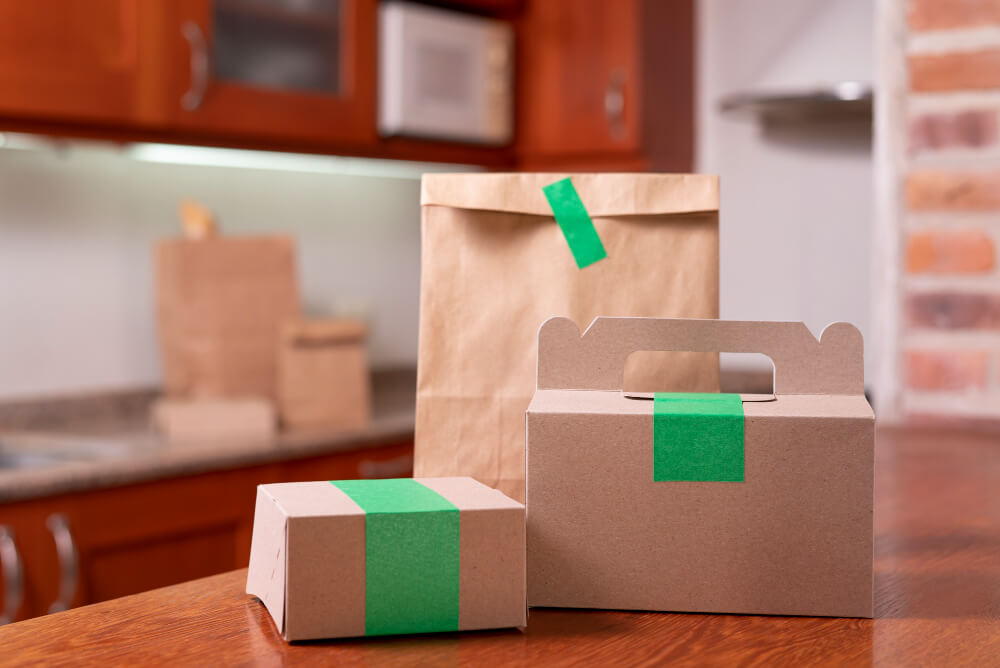
For food manufacturers, packaging is not merely an outer wrapping that facilitates the transport of the product. The choice of packaging is of critical importance in terms of the physical protection of the product, the safe execution of storage and dispatch processes, the maintenance of shelf life, and the professional presentation of the brand. Particularly for businesses with high production volumes, packaging solutions for food manufacturers must be planned according to the product’s characteristics, shipping conditions and supply chain processes. The correct use of various packaging products – such as cartons, cardboard boxes, dividers, stretch film, packing tape and cardboard corner protectors – can make the logistics and operational processes of food businesses more efficient.
Why is Packaging Important for Food Producers?
Once food products leave the production facility, they go through many different stages. During storage, palletising, loading, transport, distribution and delivery, the products must be protected against various physical risks.
The main functions of packaging include the following:
- To protect the product from physical impact
- To ensure that the products remain in good order during transport
- To streamline storage processes
- To support palletising and dispatch operations
- To help protect products from external factors
- Reducing product losses in logistics processes
- To support brand and product presentation
Particularly in factories with high-volume production, the choice of the right packaging should be assessed not only in terms of product safety but also in terms of total operating costs.
What Packaging Products Are Used in the Food Industry?
Food manufacturers’ packaging requirements vary depending on the type of product and the structure of their operations.
Products frequently used in secondary and tertiary packaging processes include the following:
- Corrugated cardboard boxes
- E-commerce and shipping boxes
- Custom-sized cardboard boxes
- Cardboard dividers
- Cardboard corner protectors
- Stretch films
- Packing tape
- Bubble wrap
- Palletising and securing products
Not all food manufacturers need to use every one of these products. The important thing is to establish a packaging system that is suited to the product’s characteristics and the supply chain.
Choosing Corrugated Cardboard Boxes
Corrugated cardboard boxes are widely used in the food sector, particularly for secondary packaging and in shipping processes.
However, not every box offers the same transport performance. When selecting boxes, the product’s weight, the box’s dimensions, stacking height, transport duration and storage conditions must all be taken into account.
For example, it may not be appropriate to transport lightly packaged food products and heavy items using the same type of box.
For this reason, when selecting corrugated cardboard boxes for food products, the total weight of the product and the transport conditions must first be analysed.
How Are Box Dimensions Determined?
When determining the dimensions of a box, the aim should be to ensure that the product can be placed inside the box without leaving any unnecessary empty space.
Use of very large boxes:
- Unnecessary consumption of materials
- Inefficient use of storage space
- The formation of gaps on the pallet
- The rise in transport costs
What could be the reason?
Using a box that is too small, on the other hand, can cause the products to become crammed together and the packaging to become misshapen.
For this reason, the production of customised boxes for food products can be assessed according to the products’ dimensions and dispatch requirements.
The Benefits of Using Custom-Sized Boxes
Standard boxes may not be suitable for every product.
The production of custom-sized boxes can offer significant advantages, particularly for manufacturers whose products come in a range of sizes.
Thanks to custom-sized boxes:
- Packaging suitable for the product is provided.
- The amount of empty space inside the box can be reduced.
- The movement of products during transport can be restricted.
- Storage space can be used more efficiently.
- The palletising pattern can be optimised.
- The use of unnecessary packaging can be reduced.
For this reason, it may be advantageous for food companies engaged in high-volume production to work with their packaging suppliers on a product-by-product basis.
Cardboard Divider Solutions for Food Manufacturers
In cases where more than one product is transported in the same box, dividers can provide significant protection.
Cardboard separators can be used, particularly for glass bottles, jars and similar items that must not come into contact with one another.
Separators separate products from one another by:
- It can reduce the risk of damage caused by contact.
- It can help to improve the organisation inside the box.
- It may restrict the movement of the products.
- It can simplify the palletising and handling process.
In particular, for food manufacturers using glass packaging, the production of cardboard dividers and the design of dividers tailored to product dimensions may be considered.
The Use of Cardboard Corner Protectors in the Dispatch of Food Products
In palletised shipments, deformation may occur due to the pressure exerted on the boxes, as well as movement during transit and stacking.
Cardboard corner protectors can be used to support the corners of pallets and the edges of products.
For food producers handling high-volume shipments in particular, the use of cardboard corner protectors can help to stabilise palletised loads.
When selecting angle brackets, the size of the pallet, the weight of the load and the stacking method must be taken into account.
The Use of Stretch Film in the Palletising Process
Securing products onto pallets in food production facilities is one of the key stages of the logistics process.
Stretch film helps to keep the boxes on the pallet together.
When choosing the right stretch film:
- The weight of the pallet
- Number of boxes
- The shape of the products
- Transport distance
- Stretching by hand or using a machine
Criteria such as these should be assessed.
Particularly in high-volume production facilities, the option to purchase stretch film in bulk can help to manage purchasing costs due to regular consumption.
Why Is Choosing the Right Packing Tape Important?
Packing tape is one of the small but crucial components of the packaging system.
In particular, the use of poor-quality tape when transporting heavy parcels may cause the parcel lids to come undone or the packaging to be damaged during transit.
When choosing packing tape:
- Package weight
- Cardboard surface
- Storage conditions
- Transit time
- Method of application
criteria such as these should be taken into account.
If food producers make regular deliveries, they may also wish to consider purchasing wholesale packing tape.
Packaging for Food Producers Who Export
The export of food products may involve longer and more complex logistics processes than domestic shipments.
Products may be exposed to transport, loading and storage conditions for longer periods.
For this reason, when food producers who export are selecting packaging:
- Transport distance
- Method of dispatch
- Palletising method
- Storage conditions
- Humidity and temperature conditions
- Product weight
- Transit time
Criteria such as these must be assessed together.
The choice of packaging, particularly for food exports, is a key purchasing criterion in ensuring that the product reaches its destination in good condition.
Packaging for Food Companies Engaged in E-commerce
The packaging requirements of food producers selling online may vary.
In e-commerce shipments, once a product has left the manufacturer’s warehouse, it goes through many stages of the delivery process.
For this reason, when selecting packaging for food products in e-commerce, consideration should be given to a design that will prevent the product from shifting during transit and sustaining physical damage.
In particular:
- Gourmet products
- Packaged foods
- Dry foods
- Coffee
- Tea
- Pulses
- Nuts and seeds
- Deli products
The secondary and outer packaging for products such as these can be designed according to the product’s characteristics.
Printed Cartons for Food Producers
Printed boxes ensure that the shipping packaging for products also serves as a tool for brand communication.
The manufacturer’s logo, brand name, product details or handling instructions may appear on the box.
Printed boxes are particularly suitable for:
- To increase brand awareness
- Creating a corporate image
- To ensure that products can be easily identified in the warehouse
- To streamline distributor and dealer operations
It may be chosen for this purpose.
For this reason, the production of printed cartons for the food sector can be regarded not only as a visual choice but also as an operational solution.
The Issue of Hygiene and Food Contact in Food Packaging
An important distinction must be made when it comes to the packaging of food products.
Primary packaging, which comes into direct contact with the product, and secondary packaging, such as cartons used to transport the products, are not subject to the same assessment.
For example, a cardboard box is, in most cases, used as outer shipping packaging rather than as packaging that comes into direct contact with food.
For this reason, during the purchasing process, the packaging should:
- Whether or not it comes into direct contact with the product
- Intended use
- Storage conditions
- Conditions of carriage
- Production and quality standards
It must be clearly defined.
Food businesses must also assess the relevant legislation and technical compliance requirements, particularly where there is direct contact with food.
How Can Packaging Costs Be Reduced?
Simply buying cheaper products is not the right approach to reducing packaging costs.
To reduce the total packaging cost, the entire packaging system must be analysed.
To do this:
- The correct box size must be determined
- Strength higher than necessary should not be used
- The order quantity should be optimised
- Pallet layout should be analysed
- Unnecessary layers of packaging should be reduced
- The number of suppliers should be optimised
- A regular order plan should be drawn up
- Packaging wastage must be monitored
Particularly in factories with high-volume production, even small differences in unit costs can add up to significant annual savings.
What Should You Look Out for When Buying Wholesale Packaging?
When purchasing packaging for food producers, quality and supply reliability are just as important as price.
When evaluating a packaging supplier, the following criteria may be considered:
Production Capacity
The supplier must have the capacity to meet the company’s monthly and annual packaging requirements.
Product Range
Being able to source different products—such as boxes, dividers, corner protectors, stretch film and tape—from the same supplier can simplify purchasing processes.
Custom Manufacturing Capability
Suppliers capable of producing boxes and dividers in product-specific dimensions can offer more flexible solutions.
Duration
Delays in the supply of packaging can directly affect production and dispatch schedules.
Quality Standard
It is important that products maintain the same quality and technical specifications across different orders.
Logistics Advantage
The distance between the supplier’s production facility and your factory should be assessed in terms of transport costs and delivery planning.
The Benefits of Working with a Single Packaging Supplier
When factories purchase a wide range of packaging products from different suppliers, the procurement and logistics processes can become complex.
Sourcing multiple packaging products from a single supplier can offer the following advantages:
- Simplifying ordering processes
- Simplification of tender management
- Scheduling of shipments
- Making stock tracking easier
- Product standardisation
- A decline in communication with suppliers
- The ability to enter into long-term price agreements
For this reason, the choice of packaging supplier for food producers should be assessed not only in terms of product quality but also in terms of the efficiency of the procurement process.
How to Choose a Packaging Supplier for Food Manufacturers?
When selecting a supplier, rather than simply comparing quoted prices, the total cost of ownership and service capacity should be assessed.
Before deciding on a supplier, the following questions may be asked:
- Can they produce the box sizes we need?
- Can it cope with our monthly order volume?
- Do you produce custom-made items?
- Can they prepare a sample?
- What are the delivery times?
- Can you produce printed boxes?
- Can they supply complementary products such as separators and angle brackets?
- Is there a quality control process in place?
- Can they handle urgent orders?
- Is it capable of long-term supply planning?
The answers to these questions can help to identify the most suitable supplier for the business, rather than simply the one offering the lowest price.
How Do You Draw Up a Packaging Procurement Plan?
In factories that use standard packaging on a regular basis, drawing up an annual or periodic purchasing plan helps to keep costs under control.
When carrying out planning, past consumption data can be analysed.
For example:
- Monthly box consumption is determined.
- Seasonal fluctuations in production are analysed.
- The average delivery time is calculated.
- The safety stock is determined.
- The storage capacity is checked.
- The supplier’s production capacity is assessed.
- An order schedule is drawn up.
Thanks to this system, disruptions to production or dispatch processes caused by packaging stocks falling to critical levels can be prevented.
Packaging solutions for food manufacturers are a key factor that goes beyond merely facilitating the transport of products, affecting the entire supply chain from production to storage and from dispatch to delivery. Details such as determining the correct box size, selecting the appropriate corrugated cardboard, using cardboard dividers and corner protectors, and choosing the right stretch film and packing tape can directly affect the total packaging cost and product safety. For businesses engaged in high-volume production in particular, working with an experienced supplier who can regularly provide bulk packaging products, custom-sized boxes, corrugated cardboard boxes for food products, cardboard dividers, cardboard corner protectors, stretch film and other packaging products can help ensure more efficient management of procurement and logistics processes.