


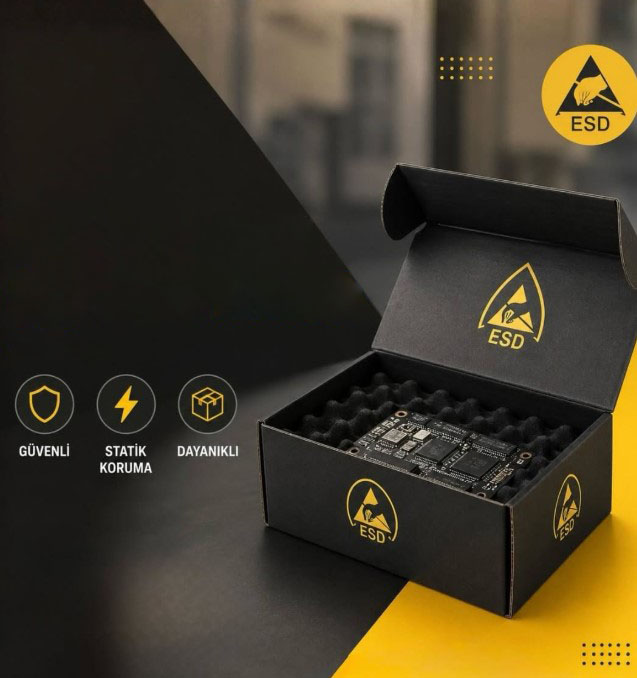
Damage caused by static electricity during the production, storage and dispatch of electronic and sensitive components can result in significant costs. For this reason, ESD packaging solutions are used, particularly when handling electronic components, circuit boards, semiconductors and sensitive industrial parts. So, in which sectors is ESD packaging used? Used across a wide range of sectors, from electronics to the automotive industry, and from the defence sector to telecommunications, ESD packaging is designed to minimise the adverse effects of static electricity discharge on sensitive products. Choosing the right ESD packaging is important not only for product safety but also for the sustainability of production and logistics processes.
What is ESD?
ESD is an abbreviation of the English term ‘Electrostatic Discharge’ and means electrostatic discharge.
A sudden electrical discharge occurring between two surfaces or objects with different electrical potentials is known as ESD. A simple example of this is the slight electric shock we feel when we touch a door handle in everyday life.
However, even electrostatic discharges occurring at much lower levels in electronic components can cause serious damage.
An electronic component may suffer a loss of performance due to ESD even without any visible damage. For this reason, appropriate ESD control is essential throughout the process from production to dispatch of sensitive electronic products.
What is ESD Packaging?
ESD packaging refers to specialised packaging solutions used to prevent or minimise damage to sensitive electronic products caused by electrostatic discharge.
ESD-protected packaging can be manufactured from different materials depending on the product’s characteristics and intended use.
These include:
- ESD bags
- Anti-static bags
- ESD boxes
- ESD foams
- Conductive packaging materials
- Static-protective packaging
- ESD-rated corrugated cardboard packaging
Various solutions such as these may be found.
The key point here is that the terms ‘antistatic’ and ‘ESD-protected’ do not always mean the same thing. When selecting packaging, the sensitivity of the product to be protected and the level of protection required must be assessed.
In Which Sectors Is ESD Packaging Used?
ESD packaging is used particularly in sectors where electronic components are manufactured, processed, stored or transported.
The main areas of application are as follows:
- Electronics industry
- The automotive sector
- Defence and aerospace industry
- Telecommunications
- The computer and IT sector
- Consumer electronics
- Industrial automation
- Medical electronics
- Robotics and mechatronics
- The semiconductor and microelectronics sector
Let us now examine these sectors in more detail.
1. The Use of ESD Packaging in the Electronics Sector
One of the most common applications for ESD packaging is in the electronics sector.
Electronics manufacturers work with a large number of sensitive components. These components may be exposed to electrostatic discharge on the production line, in the warehouse or during dispatch.
ESD protection is particularly important when handling the following products:
- Integrated circuits
- Microprocessors
- Resistors
- Capacitors
- Sensors
- Relays
- Transistors
- Electronic circuit boards
- PCBs
- Fasteners
For this reason, ESD packaging solutions are a key safety measure for electronics manufacturers, helping to protect products throughout the supply chain.
2. ESD Packaging in the Automotive Sector
The number of electronic systems in modern cars is steadily increasing.
A wide range of electronic components are used in engine control units, sensors, safety systems, multimedia systems and driver assistance technologies.
In particular, electronic components manufactured in the automotive supply industry:
- From production to the warehouse,
- From the warehouse to the assembly line,
- From the manufacturer to the main industry,
- From the supplier to the service network
ESD protection may be required during transport.
For this reason, ESD packaging has become an important solution for the automotive sector in terms of the safe transport and storage of electronic components.
3. ESD Packaging in the Defence and Aerospace Industries
Electronic systems used in the defence and aerospace sectors require a high degree of precision.
Radar systems, communication devices, control systems, avionics equipment and various electronic modules contain precision components.
Preventing ESD-related damage during the production and logistics processes for these components can be critical.
Particularly in the case of high-cost electronic components, the packaging process is just as important as the product itself.
For this reason, defence and aerospace companies can benefit from ESD-protected packaging, conductive packaging and other static electricity control solutions.
4. ESD Packaging in the Telecommunications Sector
Telecommunications equipment contains a large number of electronic circuits and precision components.
Appropriate packaging must be used when transporting electronic components used in base stations, network devices, routers, communication modules and fibre-optic infrastructure.
ESD protection can be particularly important for electronic modules that are frequently removed and refitted, especially during servicing and maintenance procedures.
5. ESD Packaging in the Computer and IT Sector
Computer hardware is among the products that are sensitive to electrostatic discharge.
Motherboards, processors, RAM modules, graphics cards, storage devices and various electronic components must be packaged under suitable conditions.
Particularly for high-volume hardware manufacturers and distributors, it is important to determine the appropriate level of protection in line with the product’s sensitivity when purchasing ESD packaging.
6. ESD Packaging in the Consumer Electronics Sector
Televisions, audio systems, smart devices, games consoles, camera systems and various other electronic products contain a large number of sensitive circuits.
Electronic components must be protected throughout the entire process, from their movement within the factory right through to delivery to the end user.
ESD-protected packaging is particularly widely used in service and spare parts operations.
7. ESD Packaging in the Industrial Automation Sector
PLCs, control boards, sensors, drives and automation modules used in factories contain sensitive electronic components.
ESD-protected packaging solutions can be used for the storage and transport of electronic components replaced during maintenance at production facilities.
In this way, the risk of spare parts being damaged by static electricity before use can be reduced.
8. ESD Packaging in the Medical Electronics Sector
A significant proportion of medical devices contain electronic systems.
It is important to ensure the safe transport of electronic modules used in patient monitors, diagnostic devices, laboratory equipment and various measurement systems.
Appropriate packaging should be used, particularly in the production and servicing processes of high-precision electronic components.
9. ESD Packaging in the Robotics and Mechatronics Sector
In robotic systems, electronic circuit boards, motor drivers, sensors and control modules work together.
ESD protection may be required during the production, assembly and servicing of these components.
Robot manufacturers and automation companies can transport sensitive electronic components using ESD packaging that is suitable for the product’s specifications.
10. ESD Packaging in the Semiconductor and Microelectronics Sector
Semiconductors and microelectronic components are among the product groups most susceptible to ESD.
In this sector, electrostatic control is important in all processes, from the production environment itself to storage, and from transport to dispatch.
Consequently, the choice of ESD packaging for semiconductor products is a critical purchasing decision in terms of product safety.
Why is ESD Packaging Important?
Damage caused by ESD does not always result in physical deformation that is visible from the outside.
Electrostatic discharge in certain components:
- In the event of a sudden breakdown,
- A drop in performance,
- A reduction in the product’s lifespan,
- Reliability issues,
- Production losses
What could be the reason?
For this reason, ESD control must be taken into account not only during the production stage of electronic products, but also during storage and logistics processes.
What Should You Look Out for When Choosing ESD Packaging?
The same packaging should not be used for every electronic product.
When selecting ESD packaging, the characteristics of the product to be protected must first be determined.
The main criteria to bear in mind are as follows:
ESD Sensitivity of the Product
It must be determined how sensitive the component is to electrostatic discharge.
Level of Protection Provided by the Packaging
An assessment should be made of the level at which conductive, dissipative, antistatic or shielding properties are required.
The Structure of Cartons and Boxes
If an ESD-protected box or carton is to be used, a design suitable for the product’s weight and transport conditions must be selected.
Internal Protection Equipment
For sensitive electronic products, the outer packaging alone may not be sufficient. Suitable inner packaging can be used to secure the product and protect it from physical impact.
Storage Conditions
The environment in which the packaging will be used, as well as the humidity and temperature conditions, should also be taken into account during the selection process.
Are ESD Packaging and Antistatic Packaging the Same Thing?
Although these two terms are often used interchangeably in everyday language, they may not have the same meaning from a technical point of view.
Whilst anti-static materials primarily help to reduce the build-up or accumulation of static electricity, the purpose of ESD-protected packaging is to provide an appropriate level of protection for sensitive electronic components against the effects of electrostatic discharge.
For this reason, rather than simply looking for the term ‘antistatic’ at the time of purchase, the product’s technical specifications and intended use should be examined.
Where Are ESD Cartons and ESD Boxes Used?
ESD-rated cartons and boxes may be the preferred choice, particularly in situations where multiple electronic components need to be transported together.
These are:
- Electronics manufacturing facilities
- Automotive supply industry
- Electronics service centres
- Defence industry firms
- Automation manufacturers
- Telecommunications companies
- Electronic components distributors
can be used in businesses such as these.
In particular, companies that regularly ship electronic components may wish to consider the production of bespoke ESD boxes and cartons tailored to their product dimensions.
Choosing a Manufacturer When Purchasing ESD Packaging
When purchasing ESD packaging, the supplier’s production and quality processes should be assessed just as carefully as the product’s technical specifications.
When selecting a packaging manufacturer, the following criteria may be taken into account:
- Production capacity
- Technical knowledge and experience
- Capability to manufacture to custom dimensions
- Technical specifications of the materials used
- Quality control processes
- Sample preparation facilities
- Order lead time
- Regular supply capacity
Particularly when purchasing in large quantities, working directly with the manufacturer can help ensure that product specifications are tailored to your needs and that the supply process is managed more easily.
Is a Carton Alone Sufficient for ESD Packaging?
ESD control is not limited solely to the choice of packaging.
In addition to packaging, the production and storage environments must also be managed appropriately to protect electronic products.
In an ESD-controlled process;
- Employees’ ESD awareness,
- Earthing systems,
- ESD work areas,
- Suitable storage conditions,
- The correct handling of goods,
- Appropriate protective equipment
Factors such as these should also be taken into account.
For this reason, ESD packaging is one of the key components of a more comprehensive electrostatic control programme.
For Which Products Should ESD Packaging Be Used?
ESD packaging has a wide range of applications.
It can be considered particularly for the following product groups:
- PCBs and electronic circuit boards
- Integrated circuits
- Microchips
- Sensors
- Processors
- Electronic modules
- Automotive electronic components
- Control cards
- PLC modules
- Robotic system components
- Precision electronic spare parts
Here, the choice of appropriate packaging must be made according to the product’s physical characteristics, sensitivity and logistical conditions.
The answer to the question ‘In which sectors is ESD packaging used?’ is not limited to the electronics sector alone. ESD-protected packaging solutions may be required in many sectors, such as the automotive, defence and aerospace, telecommunications, computer technologies, industrial automation, medical electronics, robotics and semiconductor manufacturing sectors. In particular, the use of the correct packaging during the production, storage and dispatch processes of sensitive electronic components is crucial for product safety. If you are looking for ESD packaging, ESD boxes, ESD cases, antistatic packaging or bespoke packaging solutions for your electronic products, the best approach would be to work with a packaging manufacturer who will analyse your product’s technical specifications and operating conditions to provide the correct level of protection.
Our company, Devpak Packaging, supplies ESD packaging products to every region of Turkey, particularly Istanbul, Kocaeli, Bursa, Yalova, Sakarya and the Marmara region.